Taping technique to treat coccyx pain
Dr. Lila Abbate, Doctor of Physical Therapy, at New Dimensions Physical Therapy located in Manhasset, New York, has developed a technique for distracting (pulling out) and correcting the alignment of the coccyx. It is based on the Jenny McConnell technique which is commonly used for stabilizing the patella (kneecap) or shoulder joints and similar tapes like kinesiotape which was used on the 2008 Olympic athletes to prevent injury.
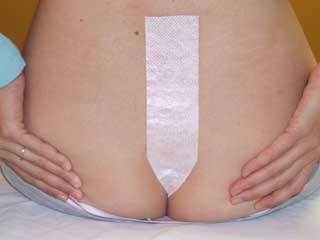
In this case, the McConnell tape is used; a white latex-free elastic underwrap, and a highly adhesive brown adhesive tape which creates and holds tension. The white tape is applied first to protect the skin and the brown tape is then applied to hold the joint in position. In the case of the coccyx, the tape is cut to a point as shown in the photos. The brown tape is applied while pulling upwards in an attempt to distract (pull out) the coccyx from its flexed position. An additional piece of tape (not shown) can pull the coccyx either toward the right or the left, should it be deviated or pull to one side. Generally, the tape is worn for 2 - 3 days before it overstretches and becomes ineffective.
Dr. Abbate has applied this method to a number of patients, and found that it worked on all but one who didn't like the feeling of the tape. If the tape works, she tells the patient to buy the tape, and will teach a family member to help them apply it. Over time, the muscles that are pulling the coccyx out of position stretch out and relax. The taping is used concurrently with internal and external physical therapy manual techniques that are used to change the position of the coccyx and stretch and normalize the surrounding muscles.
In 2024 Dr Abbate added:
I can use taping to help create a fascial tension to move the coccyx back to midline. As we know, the coccyx is only supposed to be 10% weight bearing and there is some change within in the system that will make it weight bear more than the 10%. A lot of patients have a trauma (slip and fall, being pregnant or postpartum, for example) that changes tensions on the pelvis. For those patients, the tape may help keep the coccyx more centered.
For patients who have ligamentous damage from the trauma, or severe flexion due to muscle tightness, the tape help create a tension on the coccyx that may "re-align the bones" or improves the ligamentous over-lengthening. When seen at a more acute timeframe, this can help heal. The chronic patients may benefit when taking a plane ride or long drive. I teach the patients/friend/family how to have a helper put the tape on for them.
The tape does not work for everyone. It's a specific population that it helps.
Dr Abbate's contact details are given on the list of doctors and specialists in the USA (New York).
The McConnell kneecap taping technique is discussed in this PDF document: Therapeutic Taping Techniques.
 ,
,  ,
,  ,
,
Updated 2024-07-21
