Searching for relief in Brazil
Rafael, Brazil - rafael.oliveira.br@gmail.com.
Posted 2023-05-21
My name is Rafael, and I live in São Paulo, Brazil. I am 26 years old. I work as a journalist (which involves spending a lot of time sitting) and have been an amateur jumper (participating in long jump and high jump) for almost 8 years. Despite the nature of my sport, which includes repeated falls into the sand, I have never experienced a sudden fall that could explain my coccydynia.
For those who don't have time to read my entire report, here is a summary: I have already consulted with numerous healthcare professionals, but very few of them had previous experience with my condition, and I have not seen any consistent improvement. I am still searching for a precise diagnosis. I would love to travel to Paris, New Jersey, or London to see one of the specialists mentioned on this website, but unfortunately, that is not currently an option for me. Therefore, I am sharing this report in the hopes of finding some assistance.
Pain history:
I experienced pain in my tailbone for the first time in May 2022. The pain felt like a twinge, occurring at the end of a workday when I spent a significant amount of time sitting in a chair. As I have irritable bowel syndrome and was under the care of a pelvic physiotherapist, I mentioned the pain to her, believing it could be related to a period of hardened stools.
In the following weeks, the pain would occasionally occur, usually at the end of the day or week after prolonged periods of sitting. In July 2022, during a gym session, I felt a sharp pain in my tailbone while performing hip thrusts (a pelvic elevation exercise). Although I used to do this exercise regularly, I have refrained from doing it since then.
Between July and September, the pain would sporadically appear until the end of September when it became a daily occurrence. Initially, it would only manifest towards the end of the day, but over time, it started to occur after approximately 30 minutes to 1 hour of sitting. This is my current situation, with varying levels of pain from time to time.
I was approaching an important competition scheduled for the beginning of November 2022, so I continued to practice as usual since I didn't feel any pain while running or jumping, and my pain didn't seem to worsen after a session. The problem arises when I have to sit for extended periods of time.
Since the end of October 2022, I have been working from home to have the flexibility to change positions, and I have been in this situation ever since.
After the competition, I took a break from training (including the gym) for almost two months, but unfortunately, my pain worsened during this period. In January 2023, I decided to gradually return to my sport, excluding long jump due to the risk of falls.
Since experiencing tailbone pain, I have noticed that my pelvic muscles are often tense, which is closely related to my pain. When I am able to relax my pelvic muscles, my pain improves.
Unfortunately, long periods of working in bed or sitting in an improper position (leaning forward or putting weight on one side) frequently result in sacrolumbar pain, neck pain, heel pain, thigh pain, and gluteal pain.
What I have already tried:
I discovered this fantastic website (thank you, Jon!) shortly after my pain became daily, so many of the approaches I have been trying are based on the information I read here. I am also in the process of finishing reading Dr. Foye's book, which has been very helpful as well.
One month after my pain became daily, I purchased a coccyx cushion. It helps delay the onset of pain, but it is far from solving my problem. Additionally, it causes some tension in my gluteal muscles, which is problematic.
I have also observed that ice worsens the situation, while heat provides relief.
I have already undergone a "normal" X-ray, an MRI, a CT scan, and a dynamic X-ray (thanks, Jon!).
The MRI revealed two findings:
* A disc protrusion that does not appear to be related to my coccyx pain.
* A "focal bone image in the middle portion of the first coccygeal piece, suggestive of a remnant of the notochord, without signs of aggressiveness." Initially, I was concerned that it might be a chordoma (a type of cancer). However, according to the evaluation of one of the physicians who treated me and the radiologist who analyzed the image, it is a Benign Notochordal Cell Tumor (BNCT). The doctor recommends periodic follow-up to ensure that it does not develop into cancer. One of the physicians believes that this BNCT is not related to my pain, while the other one believes that it may be related.
Based on the dynamic X-ray, the physician currently treating me has raised several possibilities, but I have not yet received a final diagnosis. One possibility is a spur, and he also observed that my coccyx appears to extend during the sitting position. Additionally, there is the presence of the notochordal remnant.
Standing x-ray and sitting x-ray:
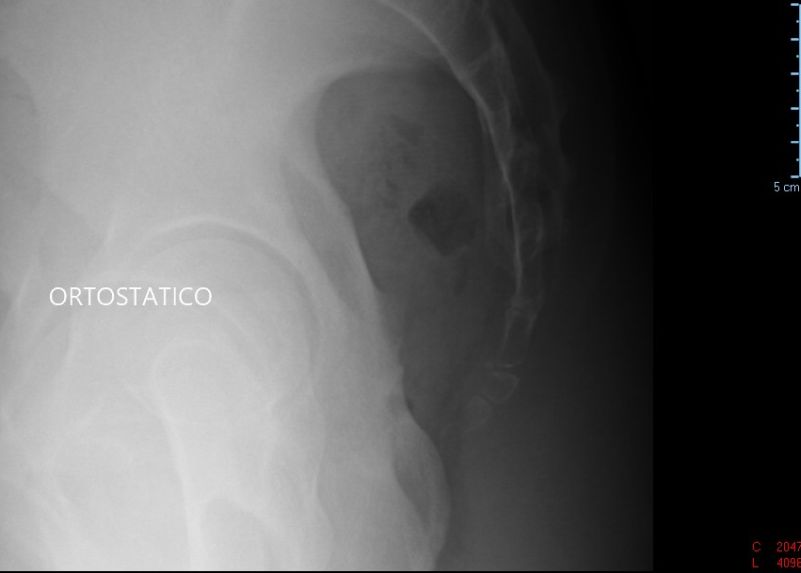
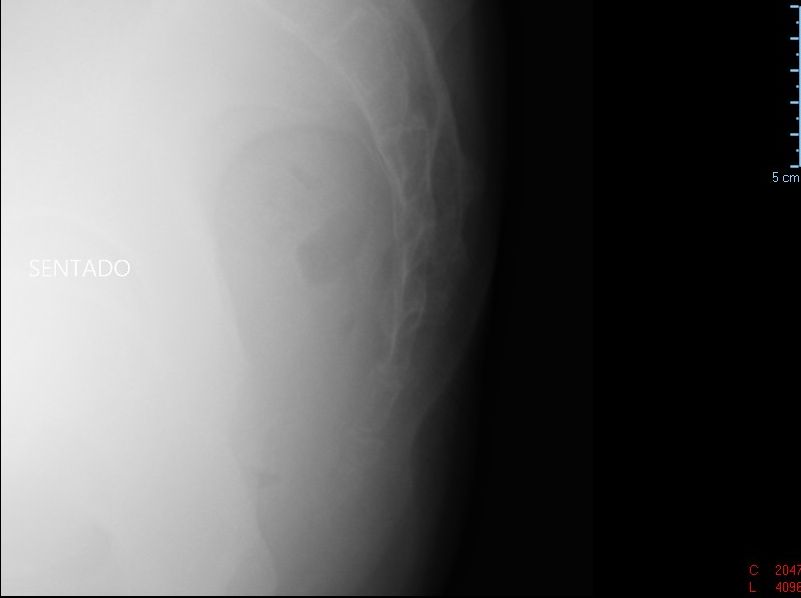
The doctor who is currently treating me is the third orthopedic spine specialist.
The first one only prescribed oral medications and a diprospan injection, and recommended strengthening the muscles in the area.
The second one prescribed more oral medications and an opioid patch (buprenorphine). It provided some relief, but I couldn't continue using it for long due to the heavy side effects.
The third doctor prescribed diprospan again and a combination of oral medications, including a lower dose of opioids. He also mentioned the possibility of injections in the coccyx region, which I haven't undergone yet.
Furthermore, I have already received treatment from six different physiotherapists, including specialists in pelvic and osteopathic therapy. I have also tried acupuncture and dry needling.
On my own initiative, one of the physiotherapists agreed to try shockwave therapy (which I read about on this website). He had never performed this therapy in the coccyx region before, and nobody else here had ever heard of this possibility. I experienced some improvement and thought it could be a definitive solution, but after some time, I returned to square one.
What I haven't tried yet:
Internal/external manipulation: I have read many personal experiences about Dr. Durtnall's work and have come across some of his writings here. The issue is that I haven't been able to find a healthcare professional with experience in this technique here in Brazil. To be honest, some of them aren't even aware of this possibility.
Coccyx injections: I have read about the different options in Dr. Foye's book, and it will probably be my next attempt. My fear is that it may only provide a temporary solution, and I'm concerned that my situation may worsen in the long term. I'm also not completely confident that healthcare professionals here in Brazil have experience with this procedure.
To conclude:
I am a journalist who has been working from home for months, missing the daily experience of a newsroom. I am also unable to travel to investigate stories due to the extended periods of sitting involved.
As an amateur athlete, I have had to give up long jumping and have also experienced other injuries related to the coccyx pain, such as thigh and gluteal pain.
Being a young person, I find myself avoiding many social situations, such as going to restaurants or traveling, where sitting is required. Additionally, I try to avoid standing for long periods as it leads to pain in other parts of my body.
Sometimes I start to believe that I will have to live with this excruciating pain forever. However, I also hold on to the hope that there is an answer out there.
If anyone, whether it's Jon, specialists, or fellow patients from Brazil or anywhere in the world, has any advice, tips, or anything to offer, it would be greatly appreciated.
You can reach me via email at rafael.oliveira.br@gmail.com..
I hope to return here soon with some good news.
