Pain-free a year after coccygectomy
John, UK - jec913@yahoo.com
Posted 2023-02-19
My Coccyx pain became apparent early 2021 and I assumed it was caused by Covid and working from home meaning I naturally spent more time sat down. Each day I was OK initially but at some stage the discomfort would gradually set in and get slowly worse the more I sat. If I sat all day, it was very sore when going to bed. To reduce the overall pain, I took to standing and working virtually all day, with occasional sit-down breaks when needed. What I predicted would be uncomfortable to sit on usually wasn't and vice versa. Sofas often seemed to be worse than hard chairs although nothing was comfortable. There were times during the Summer of 2021 where it was very angry and painful for no apparent reason i.e. I'd not necessarily done anything to aggravate it.
I tried a known-good physio and osteo respectively but despite exercises and ice for weeks, nothing fixed it, although I think the ice might have improved things somewhat, but I either had to literally stand in the kitchen, perch the ice on the edge of the worktop and gently lean my Coccyx against it. Or I would lie on my side on the sofa, with the ice perched in between my Coccyx and the back of the sofa.
In Autumn 2021, my GP sent me for an MRI and the result was "it's probably Coccydynia". They rule other things out and then assume that. I had the option of an injection which he said would only be temporary. Coccygectomy was a long waiting list and "a last resort". So I was back to square one as I didn't find their lack of enthusiasm encouraging. The NHS is amazing but it's not geared up for some issues, of which I've had other similar experiences. My gut feeling early on in all this was a Coccygectomy based on what I'd read, if I was a good candidate, would be the only cure for me. I didn't want to waste time messing around only to end up in the same situation later so this potential outcome was not an issue for me.
By this stage, I'd already started researching the situation myself on Coccyx.org (which I found to be an amazing resource and I have to congratulate both Jon Miles and all those who contributed), as well as elsewhere on the web. This is why I've documented my story.
I contacted Mr John Hardy (see Doctors and specialists in the UK, London) in December 2021 based on reading Coccyx.org multiple times prior. It was very important to me that the surgeon knew what they were doing and I had confidence in them. The testimonies on Coccyx.org clearly demonstrate all of these as did my first consultation with Mr Hardy. He is obviously someone who cares and is interested in resolving your issue taking the time when needed. After organising an MRI there with his preferred radiologist to get the required image, we subsequently went through the results and what he thought. Basically it was either injection, but again that was a temporary workaround really, or Coccygectomy which he thought would work for me. I was quite happy about this as at least there was a good chance it could be resolved. I was able to get a copy of the MRI so I could study it myself having a personal interest.
After that, an operation date was scheduled and I followed all the advice I was given by Mr Hardy. This is your best chance to avoid problems during or after.
>>> Some graphic detail in the following <<<
In the 2 weeks prior, I began ensuring I took "Lamberts FOS" (I can't do artificial sweeteners in Fibogel and the one without was out of stock) to ensure my movements were smaller and easier to pass. You don't want the opposite whilst going through this operation! I also found this helped with pretty minimal cleaning up after passing, which is also helps after the operation (I knew hard-boiled eggs helped me with this from experience too so I ate at least 1 or 2 every other day for the first week of my recovery). Also, ensure you drink plenty of water each day (and chew your food thoroughly if you don't). This is good for general health anyway. I also washed thoroughly with Hibiscrub (whole body and head as per instructions) in this 2 weeks to kill off anything unwelcome.
I had my operation on 24 February 2022 at the Lister Hospital in London which meant an early trek up to be there for 07:00. Nice private room to stay in. You wear support stockings to avoid a clot and keep these on for two weeks after (only take off when you are sleeping). Anaesthetist was a third John; Dr John Thornton who was also excellent. Operation went very well. It seemed to take about 3 seconds from going under to waking up even though it was actually 45 minutes in my case. I spent the rest of the day resting on either side watching TV. I stayed in overnight. I wasn't looking forward to passing my first motion and my first shower, but the time arrived early evening and it was a challenging on my own (I've no doubt the nurses would have helped if I'd have asked but I wanted to tackle it myself as I was on my own for the next week).
My advice here is give yourself plenty of time and be very careful as you wash what you can. For example, I bent forwards 90 degrees to wash my hair and face and dried as I went along to avoid wetting anything important. I had a waterproof dressing on but I still avoided getting any of that area wet. If you have help, a wet towel could be used to clean your back. When it comes to cleaning up after a motion, you can't wipe backwards if you do that normally. I'd recommend learning to "dab" with a side-to-side motion or wipe forwards. I used strong toilet roll slightly damp from the tap to assist. Once I knew I was done, I'd finish carefully with an anti-bacterial wipe careful in that area to ensure it was as clean. Take the time to ensure you leave the area thoroughly clean though to minimise any risk of infection. In fact, give yourself plenty of time for everything physical you do after the operation. Give yourself time to heal slowly but well. Avoid ice too as it can burn and damage tissue. Something else I did was I sat further forward on a typical toilet as the last thing you want is any water from the toilet bowl anywhere near the wound! I also found this placed less strain on the wound area and you don't want to sit back on that on the back of the toilet seat either.
Lister Hospital were very good. I had two nurses covering my time there and they were both excellent. It helped they were seasoned veterans with post-op Coccygectomies.
The next day I moved to the Best Western hotel near Victoria station for a week which I pre-booked. Mr Hardy advised I stayed in the area for a week in case of complications. I wasn't really looking forward to the whole thing but I just got on with it. The sooner you do it, the sooner it is done! Although that said, I really enjoyed my week in London.
Mr Hardy recommended I start walking as soon as I was able and did what I could manage. "Use it or lose it" which is one of my philosophies anyway. So the next day after lunch, I walked but took it easy the half mile to the Best Western. The Best Western didn't have a restaurant or any kind of food (except a breakfast bag you could pre-order). This was good as it turns out as I basically had to walk to either of the local Sainsburys stores most days to pick up my next meal or two (no fridge in the room so I had to shut the window on a supported carrier bag to keep anything cold – my room overlooked the train tracks which helped as no one around!). I also had to walk to the Lister itself and I also mixed things up with a trip to the Victoria Coach Station, and single trips to the "local" McDonalds and a "local" chippy. I felt spoiling helps with the mental side of things and why not? However, my diet is normally very good so I was confident on that front. None of these eateries were on my door step and I ended up clocking up 30000 steps over the next week. My room was on the first floor which also gave the area a different type of exercise whilst ascending stairs. I found it stiff in the Coccyx area each morning when I left the hotel each day (I likened it to how I imagine it would feel if a horse kicked you there) but it eased somewhat with some walking. I was able to work all week standing up using my laptop on my suitcase for a makeshift desk. If I needed a break, I could lie down on the bed. The Coccyx is gone so the pain after is the scar, swollen adipose / soft tissue.
I had to visit the Lister on the Tuesday to get a dressing change as I was there on my own. All good.
I left a week later. I walked to Victoria, stood on the train the whole way home and then lied on my side on the back seats of our car for the last couple of miles home. Once home, Mr Hardy advised when lying down, mix it up and switch sides every 30 minutes. This stops the blood gradually pooling in the Coccyx area helping to avoid a Haematoma. I had quite a lot of bruising either side of the wound so one of the nurses recommended palpating gently either side to help disperse it. I won't know if it helped or not but I never got a Haematoma although I still used the pads just in case for a while after the operation. I think it was two weeks was the "danger zone".
Mr Hardy gives you exercises to do at a certain stage after. Do these religiously for the full timescale. These are to change the loading on your pelvic floor and get it used to you sitting again. I also massaged the area gently in shower to help disperse blood and de-sensitise the nerves as recommended by one of the nurses.
I found the post-op support from Mr Hardy was excellent and sometimes beyond what I was expecting. It's quite obvious Mr Hardy cares for his patients. Amusingly as I look back, I repaid this with periodic pictures of my backside which I'm sure were not appreciated but necessary to check it was healing well. It must be no different to a window cleaner looking at windows…
I've included an image I created from the original of my removed Coccyx taken by Mr Hardy after removing, and the latest MRI I had prior. It shows them in relation to each other and my interpretation of how they tie up (which took a bit of understanding on my part with help from Mr Hardy!).
C1 was deliberately broken in two to get it out as it was quite big apparently. C2 and C3 were fused. Notice how angry my Sacrococcygeal joint looked from the MRI!
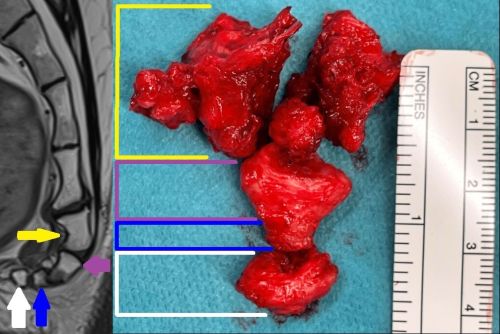
In terms of cause of pain, I'd fallen back onto the square edge of a rectangular concrete doorstep when I was late single-digit age and bruised my Coccyx then. This might explain the mess which was C2, C3 and C4. This also seemed to be the most likely cause initially but I'd had no issues for 40 years. Also, the joint was apparently not arthritic. However, during the operation, Mr Hardy found a small round ball of cartilage which he believes was eating away at my Sacrococcygeal joint. Having thought about it, 10 years prior I remembered going through a phase of stretching my back in the kitchen of a morning and stretching quite far pushing my bottom cheeks together. I'd carry on until eventually I heard a click sound from my Coccyx area (like you get from a knuckle or another joint which is what I thought it was). I didn't realise at that stage I was possibly damaging the area it seems and this may have been the cause. Apparently, I was not the only patient who had done this and ended up in the same situation. There was a chance I might have still got some pain, despite complete Coccyx removal, as there is a slight spur on the base of what remains but during the operation, Mr Hardy said the whole of that remaining surface was smooth.
In terms of the journey to becoming pain-free, I've been lucky and it seems like that is now the final outcome of this operation. For that, I'm eternally grateful.
I think my recovery has probably taken a lot longer than average although that depends on what you read.
From having the operation in February 2022, I was still getting discomfort in August 2022 (6 months on) although by that stage, it was better than the pain I experienced from Coccydynia. So if that was what I was left with, I was happy to live with it.
However, when October 2022 came, I suddenly realised it had improved still further.
From October 2022 until December 2022, I still had the odd day where if I had sat on it for long enough during the day, I might feel a slight discomfort if I sat on the bed before going to bed.
By January 2023 and now one year on in February 2023, that seems to have gone as well so now I think the pain might have completely gone.
If you are suffering from Coccydynia, my advice is to get a proper MRI done (under the supervision of Mr Hardy or someone else of high calibre), so you at least know what you are dealing with.
It's not cheap but I look at it in terms of value for money rather than cost. Nor is it a pain-free experience, but in my case and being 47 now, I might have 30 or more years left on this planet and living with Coccydynia when you do have a choice is not worth it. It's constantly nags away at you every day and I believe in time; will affect your mental health unless you can find ways to deal with it which I've read are possible. Was it worth what I went through to get where I am now? Absolutely.
